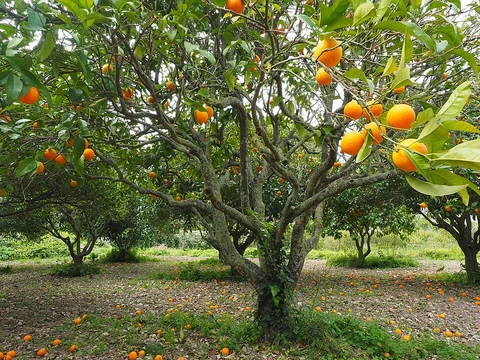
Pomegranate
Ancient fruit domesticated in Iran, now cultivated worldwide.

The pomegranate (Punica granatum) is a fruit-bearing, deciduous shrub in the family Lythraceae, subfamily Punicoideae, growing 1.5–5 metres tall. Originating in the region spanning the Caucasus and the Iranian plateau, it was first domesticated by ancient Iranians about 5,000 years ago. Rich in symbolic and mythological associations, it has been cultivated across West Asia, South Asia, Central Asia, Africa, the Mediterranean, the Americas, and elsewhere.
- origin
- Caucasus and Iranian plateau (modern-day Iran, Turkmenistan, Afghanistan, Pakistan)
- domestication
- About 5,000 years ago by ancient Iranians
- height
- 1.5–5 metres (5–16 ft)
- family
- Lythraceae, subfamily Punicoideae
- fruit_type
- Berry with edible seeds and pulp
- leading_producers
- India and China
Lore & Background
The pomegranate was first domesticated by ancient Iranians in the Iranian plateau and nearby regions about 5,000 years ago. From the Iranian plateau, the pomegranate was exported to other parts of Asia including Iraq, Turkey, and India, as well as parts of Africa and Europe. Remains of the fruit dating to the Neolithic period have been found at Gezer in Israel/Palestine, and carbonised pomegranate exocarp has been recovered from early Bronze Age levels at Tell es-Sultan (Jericho) in the West Bank. Additional remains from this period have been found at Arad and Gezer in Israel, and from the Late Bronze Age at Hala Sultan Tekke in Cyprus and Tiryns in Greece. A large, dry pomegranate was found in the tomb of Djehuty, the butler of Queen Hatshepsut in Egypt.
Reader's Guide
The pomegranate holds significance as one of the earliest domesticated fruit trees, with a history spanning over five millennia. Its cultivation spread from its native Iranian plateau across Asia, Africa, Europe, and the Americas, making it a globally recognised fruit. The plant is drought-tolerant and can be grown in Mediterranean or summer rainfall climates, though it is susceptible to root decay in wetter areas. The fruit is used in traditional Persian cuisine, notably in dishes such as fesenjān, kabab torsh, and zeytoon parvardeh, where pomegranate molasses adds a sweet-sour flavour. Pomegranate juice is also used in baking, cooking, juice blends, garnishes, nonalcoholic drinks, and cocktails. The leading global producers are India and China, followed by Iran, Turkey, Afghanistan, the US, Iraq, Pakistan, Syria, and Spain. The name 'pomegranate' derives from medieval Latin pōmum (apple) and grānātum (seeded), and the modern French term grenade gave its name to the military grenade.
Did You Know?
- The pomegranate was first domesticated by ancient Iranians about 5,000 years ago.
- The name 'pomegranate' derives from medieval Latin pōmum (apple) and grānātum (seeded).
- The modern French term for pomegranate, grenade, gave its name to the military grenade.
Origins & the Long Journey from the Iranian Plateau
The pomegranate's story begins on the Iranian plateau and the surrounding Caucasus region, spanning what are now Iran, Turkmenistan, Afghanistan, and Pakistan. Ancient Iranians are credited with first domesticating the fruit roughly five millennia ago, transforming a wild shrub into a cultivated crop that would eventually reshape cuisines and economies across multiple continents. From its homeland, the pomegranate traveled outward through trade and migration, reaching Iraq, Turkey, and India, as well as parts of Africa and Europe. Its journey to the Western Hemisphere came much later: Spanish settlers brought it to Spanish America in the late sixteenth century, and to California specifically in 1769. Today, the fruit is cultivated across West, South, and Central Asia, north and Sub-Saharan Africa, drier parts of Southeast Asia, the Mediterranean basin, the United States, and Chile. In the Northern Hemisphere, harvest season runs from September through February, while Southern Hemisphere growers pick their crop between March and May.
Botanical Architecture & the Fruit's Inner Design
The pomegranate is a deciduous shrub or small tree in the family Lythraceae, reaching heights between 1.5 and 5 metres, with multiple spiny branches and glossy, narrow oblong leaves measuring roughly 1.9 to 5 centimetres in length. Its flowers, bright red or white and at least 3 centimetres across, bear three to seven petals, and some cultivars are grown purely for their ornamental blooms. Internally, the ovary is divided into compartments called locules, each holding numerous suspended ovules. The mature fruit is botanically a berry, with a hard outer pericarp and a spongy inner mesocarp forming asymmetric chambers. Seeds, numbering anywhere from 200 to roughly 1,400 per fruit, are not attached to the mesocarp but sit freely within these chambers, each encased in a thick fleshy seed coat called a sarcotesta. Wild fruits range from 2 to 8 centimetres in diameter, while certain cultivars push to 12 centimetres. Squeezing the seeds releases a tart juice with a pH around 4.4, rich in polyphenols, anthocyanins, and ellagitannins that give it a deep red colour capable of leaving indelible stains on fabric.
Culinary Heritage & the Kitchen's Favourite Sour-Sweet
In traditional Persian cooking, pomegranate molasses stands as a cornerstone ingredient, lending a distinctive sweet-sour depth to stews, sauces, and marinades. Classic dishes such as fesenjān, kabab torsh, and zeytoon parvardeh all depend on this concentrated flavour to define their character. Beyond the molasses, the whole fruit and its juice find their way into baking, everyday cooking, blended juices, table garnishes, nonalcoholic beverages, and cocktails across many cuisines. The fruit's natural tartness, driven by a low pH of about 4.4 and a high concentration of polyphenols, makes it a versatile counterpoint to richer, sweeter ingredients. Seasonality shapes how the fruit appears on menus: Northern Hemisphere kitchens enjoy fresh pomegranates from September through February, while Southern Hemisphere cooks work with the crop from March to May. The deep red pigmentation of the juice, produced by anthocyanins and ellagitannins, is both a visual asset and a practical caution, as it can leave stubborn, indelible stains on fabrics and surfaces in the kitchen.
Etymology & a Name That Outlived the Fruit
The very name "pomegranate" is a linguistic fossil, assembled from medieval Latin pōmum (apple) and grānātum (seeded), likely filtered through the Old French pomme-grenade. In early English, the fruit was called "apple of Granada," a phrase that survives today only in the formal language of heraldic blazons. The fruit's influence on language extends far beyond its own name. The gemstone "garnet" borrows from Old French grenat, itself a metathesis of Medieval Latin granatum, originally used to describe a dark red colour, possibly referencing the hue of pomegranate pulp or the red dye cochineal. Even the military grenade traces its name to the modern French word for pomegranate, grenade, evoking the fruit's round, spiky exterior. In Ireland, the fruit was colloquially known as "wineapples" or "wine-apples," a term that has largely faded from everyday speech but still lingers at the Moore Street open-air market in central Dublin, a small living thread connecting modern shoppers to a bygone culinary vocabulary.
Frequently Asked Questions
What is Pomegranate?
Pomegranate (Punica granatum) is a deciduous, fruit-bearing shrub classified in the family Lythraceae, subfamily Punicoideae. It typically stands between 1.5 and 5 metres tall and produces a berry whose edible seeds and surrounding pulp make it a widely valued crop.
Where did Pomegranate originate and when was it first domesticated?
The species is native to the broad region stretching from the Caucasus across the Iranian plateau, encompassing parts of present-day Iran, Turkmenistan, Afghanistan, and Pakistan. Ancient Iranians first brought it under cultivation roughly 5,000 years ago.
Where is Pomegranate cultivated today?
Although it began as a West Asian and South Asian crop, pomegranate has since been planted across Central Asia, North Africa, the Mediterranean basin, the Americas, and many other parts of the world.
Why is Pomegranate culturally significant beyond its use as food?
The fruit carries a rich web of symbolic and mythological associations that have made it a recurring motif in art, religion, and folklore across numerous civilizations. Its five-millennium history of domestication and its spread to virtually every continent have cemented its status as one of the most culturally layered fruits in the plant kingdom.
More in Common Plants And Crops 25-30
Elsewhere in the Common Plants And Crops universe
Spotted an error? Know more?
This is a living reference — every entry is fact-audited, and reader corrections feed straight into our audit queue. Suggest an edit · See this site's audit record