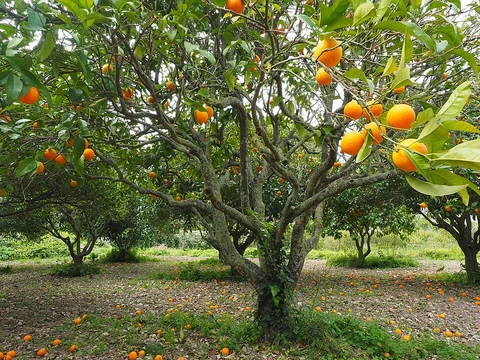
Plum
Plums are an ancient domesticated fruit, dried as prunes.

Plums are the fruit of some species in the genus Prunus, subgenus Prunus. They are likely to have been one of the first fruits domesticated by humans, with origins in Eastern Europe, the Caucasus Mountains, and China. Dried plums are usually called prunes. Plums are a diverse group of species, with trees reaching a height of 5–6 metres (16–20 ft) when pruned. The fruit is a drupe with firm and juicy flesh. Plums can be eaten fresh, dried to make prunes, used in jams, or fermented into wine and distilled into brandy. Plum seeds contain the cyanide-like poison amygdalin.
- Type
- Fruit
- Domestication
- One of the first fruits domesticated by humans
- Origin
- Eastern Europe, Caucasus Mountains, China
- Major Producers (2023)
- China (55% of world total), Romania, Chile
- Height (pruned)
- 5–6 metres (16–20 ft)
- Key Species
- Prunus domestica (European), Prunus salicina (Japanese/Chinese)
- Notable Toxin
- Amygdalin in seeds
Lore & Background
Plums are likely to have been one of the first fruits domesticated by humans. Three of the most abundantly cultivated species are not found in the wild, only around human settlements: Prunus domestica has been traced to East European and Caucasian mountains, while Prunus salicina and Prunus simonii originated in China. Plum remains have been found in Neolithic age archaeological sites along with olives, grapes and figs. According to Ken Albala, plums originated in Iran. They were brought to Britain from Asia. An article on plum tree cultivation in Andalusia (southern Spain) appears in Ibn al-'Awwam's 12th-century agricultural work, Book on Agriculture. Plum cultivation is recorded in medieval monasteries in England. A garden with 'ploumes' and 'bulaces' is referred to by Chaucer. The cultivation of plums increased during the 17th and 18th centuries. During this period greengages were given their English name and the Mirabelle plum became firmly established. Advances in the development of new varieties in England were made by Thomas Rivers. Two examples of River's work are the varieties Early Rivers and Czar.
Reader's Guide
Plums hold significance as one of the earliest domesticated fruits, with archaeological evidence from Neolithic sites alongside olives, grapes, and figs. Their cultivation spread from Eastern Europe, the Caucasus, and China to Britain and Andalusia, as documented in Ibn al-'Awwam's 12th-century work. In 2023, China produced 55% of the world's plums, with Japanese or Chinese plums dominating the fresh fruit market due to their large size, juiciness, and long shelf life. European plums remain common in some regions and include varieties such as Damson, Greengage, Mirabelle, and Victoria. Plums are versatile: eaten fresh, dried as prunes, made into jams, fermented into wine, or distilled into brandy like slivovitz in the Balkans. The fruit's seeds contain amygdalin, a cyanogenic glycoside. The name 'plum' derives from Old English, ultimately from a loanword from an unknown language of Asia Minor. Plums are also used in traditional dishes worldwide, from Japanese umeboshi to Chinese salted plums. Their legacy includes both culinary and economic importance, with ongoing cultivation and hybridization.
Did You Know?
- Plum seeds contain amygdalin, a cyanide-like poison.
- In 2023, China produced 55% of the world's plums.
- The name 'plum' comes from Old English, ultimately from a loanword from an unknown language of Asia Minor.
More in Common Plants And Crops 1-24
Elsewhere in the Common Plants And Crops universe
Spotted an error? Know more?
This is a living reference — every entry is fact-audited, and reader corrections feed straight into our audit queue. Suggest an edit · See this site's audit record